Listen on Spotify
You Can Listen to to the full podcast on Spotify, by clicking Here

A festive review of GFD Homes’ Santa interview examines the decline of traditional chimneys and the role of Composite Doors in home insulation, draught reduction and design. It also considers the Solidor-versus-Comp Door choice and the practical lead times for custom installations.
Chris and Kim discuss how holiday hosting, home appearance and renovation deadlines shape purchasing decisions. The interview and discussion are AI-generated, and product specifications, energy-saving claims, and delivery or fitting availability should be confirmed with GFD Homes.
Santa’s comments certainly got people talking
Santa’s comments certainly got people talking.
Additionally, two podcast presenters were invited to examine his surprising views on modern front doors.
What started as a light-hearted Christmas interview became a fascinating discussion about home design.
Moreover, it explored energy efficiency and why Father Christmas might retire his chimney-climbing days.
Join Chris and Kim as they review GFD Homes’ interview with Father Christmas.
From the decline of traditional chimneys to modern front doors, it discusses warmth and the Solidor vs Composite Doors dilemma.
You can read the full interview here
Podcast transcript
For a deep dive into a global celebrity, the material usually focuses on their tour riders. Alternatively, it may highlight an eccentric investment portfolio, such as Composite Doors.
Kim (00:08): right? Something a bit scandalous.
Chris (00:10): Yeah, exactly. But today we are looking at someone who works exactly one night a year.
Kim (00:16): Oh, and travels at completely mind-bending speeds.
Chris (00:19): Yes, and has somehow managed to dodge parking fees for well several centuries now.
Kim (00:25): I mean, it requires a highly specialised set of skills, plus a surprisingly clean driving record. You know, considering the airspace he navigates.
Chris (00:32): Seriously, and while this deep dive usually tackles dense scientific research or historical archives, today’s material offers something completely unexpected. We are analysing an exclusive, albeit entirely fictional, and very festive interview with Father Christmas himself.
Kim (00:49): Yeah, the framing device is just brilliant because what we are actually looking at is a piece of holiday marketing from a company called GFD Homes.
Chris (00:58): Right.
Kim (00:58): But if you look past the whole festive gimmick of a fictional interview, the narrative they’ve constructed reveals some surprisingly grounded truths about well modern architectural shifts.
Chris (01:08): So our mission for you today is to unpack what this quirky little narrative actually tells us about our own homes. We’re going to look at the evolution of home heating and why front doors have become the absolute unsung heroes of thermal dynamics.
Kim (01:23): Yeah, and why this marketing campaign so cleverly leverages holiday anxiety to urge homeowners to just beat the ticking clock for winter installations.
Chris (01:32): Exactly, because whether you are prepping your house for a barrage of family guests this season, or you’re just desperately tired of freezing every time you walk through your own hallway, you know the underlying science wrapped up in this entertaining narrative is incredibly practical.
Kim (01:47): It really is.
Chris (01:48): So where do we start?
Kim (01:49): Let’s start with what I can only describe as Santa’s core logistical nightmare in the 21st century.
Chris (01:56): Oh, the chimney rant.
Kim (01:57): Yes, the big man is incredibly frustrated with modern architecture, he goes on this hilarious rant about modern housing estates, pointing out that half the houses don’t even have chimneys anymore,
Chris (02:07): and the ones that do,
Kim (02:08): which is a huge problem for him,
Chris (02:10): and the ones that do, he absolutely despises modern log burners.
Kim (02:15): Well, I mean, they represent a serious workplace hazard for him now. He talks about how back in the day he had these massive Victorian fireplaces to work with,
Chris (02:23): right? Just a huge opening,
Kim (02:25): exactly-a clear, wide drop right into the living room.
Chris (02:28): But now he complains he’s expected to squeeze through modern flues that are, and this is a direct quote, barely wider than a Pringles tube.
Kim (02:37): A Pringles tube.
Chris (02:38): I know, and there’s this amazing detail in the text, where he admits that last Christmas he actually got stuck halfway down a flue in Surrey.
Kim (02:46): Oh wow!
Chris (02:46): Yeah, Rudolph literally had to pull him out from the roof. He calls it most embarrassing and complains that the dry cleaning bill for the soot covered red suit was just astronomical.
Kim (02:57): I mean, just picture that physical reality for a second, right? Trying to shove a jolly man in a heavy winter suit down a modern metal flue-it’s
Chris (03:06): like trying to violently stuff a puffy winter coat back into one of those tiny travel packing cubes.
Kim (03:12): That is exactly what it’s like.
Chris (03:15): You’re either going to rip the fabric, or you know, in Santa’s case, get wedged behind someone’s wood-burning stove,
Kim (03:21): which nobody wants, but that visual actually highlights a massive structural shift in how our homes are engineered today.
Chris (03:28): How so?
Kim (03:29): Well, for centuries, the hearth, like the open fireplace, was the literal and figurative centre of the home. Structurally, it was massive, but open fires are just terribly inefficient.
Chris (03:39): Right, because of the draft.
Kim (03:41): Exactly, they require huge amounts of airflow, meaning you have a giant masonry hole going straight through the roof. 90% of the heat you generate just goes straight up that Victorian chimney.
Chris (03:53): So you’re basically trying to heat a room while simultaneously vacuuming all the hot air out of it.
Kim (03:57): Precisely, which is why we engineered our way out of them, as we shifted to central heating and now to these highly efficient narrow fluid log burners, that architectural focal point vanished.
Chris (04:08): Oh, I see.
Kim (04:10): Yeah, a modern log burner doesn’t need a massive masonry chimney. It just needs a highly insulated narrow metal pipe to draw just enough air to keep the fire efficient. So the house basically becomes a sealed thermal envelope.
Chris (04:23): Okay, so if the roof is no longer this massive open thermal hole, the vulnerability of the house shifts. The chimney is entirely obsolete as a point of entry for a guy in a red suit.
Kim (04:34): Right, meaning Santa needs a new way in,
Chris (04:37): which explains Father Christmas’s newfound passion. He has apparently become a massive front door enthusiast.
Kim (04:42): Oh, he really has.
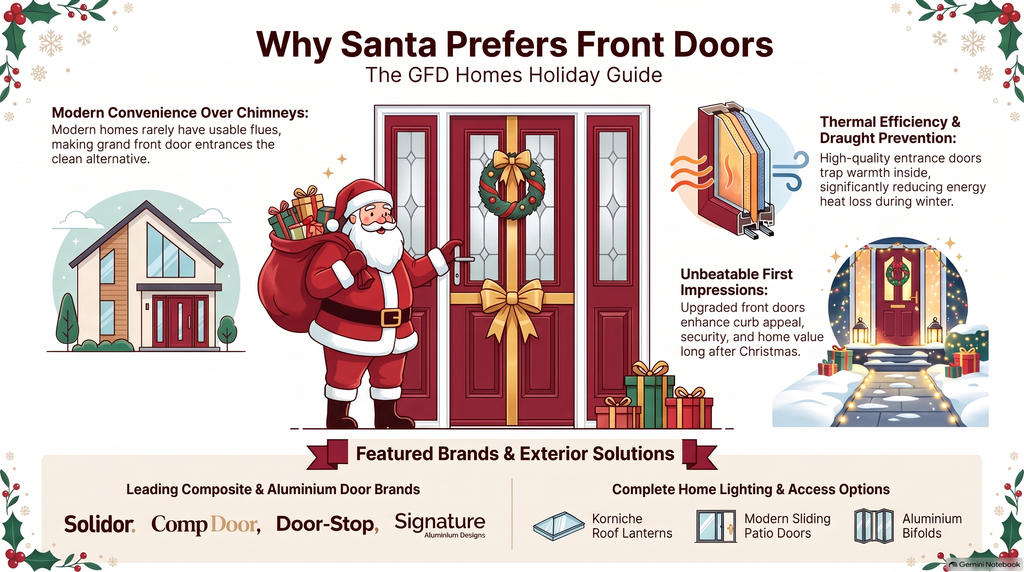
Chris (04:43): He claims he can spot a lovely new GFD Home’s front door from halfway down the street. The interview actually has him explicitly name dropping major brands like Solidor, Comp Door, Door-Stop, and Signature Aluminium.
Kim (04:57): He’s very specific.
Chris (04:58): He is, and he. Argues that rather than doing the whole archaic chimney routine, he’d much rather use a little Christmas magic to make a grand entrance through a beautiful composite door.
Kim (05:08): Well, you can see the immediate benefits for his workflow, right? You walk through the door, put the presents under the tree, and leave everything exactly as you found
Chris (05:16): it. No soot on the carpet.
Kim (05:17): Exactly. No cobwebs on the suit, and no explaining to Mrs Claus why he’s ruined another pair of trousers in a narrow flue.
Chris (05:25): It’s all about presentation for him. He says, “Look at me: red suit, black boots, magnificent beard. I’ve been working this look for centuries. Presentation matters.
Kim (05:34): He’s not wrong.
Chris (05:35): No, but I do have to push back a little bit on the physics here.
Kim (05:38): Okay, go ahead.
Chris (05:40): Sure, a brand new solid door or Comp Door looks fantastic, but is a front door really doing that much heavy lifting when it comes to the actual thermal performance of the house?
Kim (05:49): You’d be surprised
Chris (05:50): because compared to say injecting foam wall insulation or upgrading all your windows to triple glazing, is a door really moving the needle on warmth? I mean, explain how doors improve your home warp.
Kim (06:02): That assumption that the front door is mostly just esthetic is incredibly common, but the science of thermodynamics paints a very different picture.
Chris (06:08): Really?
Kim (06:09): Oh, definitely. And the interview tackles this perfectly by having Santa note that at the North Pole, keeping the warmth inside is absolutely essential.
Chris (06:17): I mean, obviously, it’s North Pole,
Kim (06:19): right? Mrs Claus apparently has the heating on from September until approximately July, because he says it gets colder than a penguin’s freezer.
Chris (06:27): I love the idea of Santa sweating over the winter heating bills.
Kim (06:31): He literally says every time an elf leaves the front door open, he can practically hear the money disappearing.
Chris (06:35): Oh wow!
Kim (06:36): And that visualization is actually a great way to understand heat loss. Imagine your central heating as water you are constantly pouring into a bucket.
Chris (06:43): Okay, I’m picturing it.
Kim (06:45): If you have great loft insulation and double glazing, you’ve plugged most of the little holes in that bucket. But if your front door is an old warped wooden frame or maybe a poorly fitted early generation uPVC door,
Chris (06:56): yeah,
Kim (06:57): it acts like a massive gash in the side of the bucket. You are just pouring hot air out into the street.
Chris (07:02): Oh, that makes sense. Let’s break down those materials actually, because the evolution is fascinating. People have this really romantic idea of an old solid oak door.
Kim (07:10): They do, yeah.
Chris (07:12): But wood is a living material. It expands in the humidity. It shrinks in the cold. Over 100 years, that door warps
Kim (07:19): dramatically. It
Chris (07:20): pulls away from the frame, creating literal air gaps where convection happens, which means cold draughts blowing straight into your hallway.
Kim (07:27): Exactly, and then the industry tried to solve that with uPVC in the 1980s and 90s. The
Chris (07:33): plastic doors,
Kim (07:34): right? The idea was to use plastic because it doesn’t rot like wood does, but early uPVC doors had terrible structural integrity and suffered from significant thermal expansion issues.
Chris (07:46): Oh, so they warped too?
Kim (07:47): Yes, the plastic would heat up in the sun and warp within the frame, creating the exact same draft problems as wood, just with a much cheaper esthetic.
Chris (07:56): Which brings us to the composite doors Santa is raving about. Why are they fundamentally different?
Kim (08:02): So composite doors are an exercise in modern engineering. They combine multiple materials, usually a timber core or a high-density polyurethane foam core, wrapped in a really durable glass-reinforced plastic.
Chris (08:15): Okay.
Kim (08:15): The crucial element here is the solid thermal core. It is designed specifically to prevent something called thermal bridging.
Chris (08:23): Thermal bridging. Think of that like a physical highway for cold air, right?
Kim (08:27): Exactly.
Chris (08:28): So, if a door frame has continuous solid materials like older metal or solid wood going straight from the freezing outside to the warm inside, the cold just travels right down that physical highway and radiates into your hallway.
Kim (08:40): Yes, and a high-density foam core acts like a roadblock. It severs the highway. Oh, I see. The conductive heat loss is stopped dead, and when you combine that thermal roadblock with modern compression-fitted weather seals that eliminate those convective draughts we talked about, then the
Chris (08:55): door finally completes the thermal envelope of the house.
Kim (08:58): Bingo! It traps that expensive heat inside.
Chris (09:02): So when Santa is admiring these doors, he’s not just looking at the beautiful colours or the decorative glass. He knows that a well-fitted Composite Doors system stops heat escaping from the home.
Kim (09:13): Exactly, it’s a functional thermodynamic barrier, not just a decorative piece of architecture.
Chris (09:19): And the GFD Homes marketing team knows this is a massive pain point for consumers. Right, keeping the hallway warm in December is just as vital for you, the homeowner in London, as it is for the North Pole Cottage. Speaker 4 09:31 Definitely.
Chris (09:32): Speaking of the North Pole Cottage, the narrative takes a really interesting turn here into domestic sociology.
Kim (09:37): It’s so funny
Chris (09:38): because even magical beings apparently suffer from severe renovation decision fatigue. Santa reveals this ongoing domestic dispute between him and Mrs Claus over picking a new door for their own home.
Kim (09:51): It basically proved that no one, not even a magical entity, is immune to the paradox of choice.
Chris (09:56): Mrs Claus apparently spotted a beautiful solid door on a house she liked in York. Sure, and asked Santa why they didn’t have one.
Kim (10:03): And what did he say?
Chris (10:04): Santa, playing the classic reluctant renovator who just doesn’t want to deal with a project, tried to argue that their existing door had been perfectly adequate for the last 200 years. Speaker 5 10:14 Ooh,
Chris (10:15): yeah,
Kim (10:15): which is universally understood to be the wrong answer in any domestic partnership.
Chris (10:21): Truly, a rookie mistake for a guy who’s been married for centuries.
Kim (10:24): Yeah, he should know better.
Chris (10:26): So now they are actively looking at replacing it, but Mrs Claus is completely torn by the modern market. On one hand, she loves the look and feel of the Solidor, especially those traditional temporary core designs that look historically accurate against their snowy cottage.
Kim (10:40): Sure,
Chris (10:41): but then she discovered Compdor, which is known for a slightly different internal composition and a vast array of hardware. The
Kim (10:48): variables are just overwhelming. When you go from a 200 year old slab of wood to a modern digital catalog, you aren’t just buying a barrier anymore; you’re designing an architectural element from scratch.
Chris (10:59): Right, and Santa says every single evening it’s the exact same conversation. Nicholas, what do you think of this one? With his colour work with the windows, should we have decorative glass?
Kim (11:10): Oh, poor guy.
Chris (11:10): He actually complains that organising the logistics of delivering 400 billion presents across the globe is considerably less complicated than choosing a single front door with his wife.
Kim (11:20): I believe it. The sheer volume of customisation options on a site like GFD Homes can easily induce choice paralysis.
Chris (11:27): Yeah,
Kim (11:28): and it’s not just the main doors. Santa mentions noticing these incredible Signature Aluminium doors on contemporary homes, and even Korniche roof lanterns.
Chris (11:36): Roof lanterns.
Kim (11:37): Yeah, he says he lands his sleigh on roofs and finds himself thinking that’s a lovely roof lantern, though he does have to repeatedly warn Rudolph not to land heavily on the architectural glass.
Chris (11:47): That’s a great detail, but I do have a highly logical question here that the text actually anticipates.
Kim (11:52): Okay, let’s hear it.
Chris (11:53): If he is Father Christmas, and he has hundreds of magical elves at his disposal plus infinite Christmas magic, why doesn’t he just conjure up a new door? Why are they sitting at a laptop scrolling through a UK retailer’s website?
Kim (12:08): It’s a fair question, and the narrative handles that beautifully. Santa says he suggested exactly that. He told Mrs Claus they could just have the elves whip something up,
Chris (12:17): and
Kim (12:18): but she gave a brilliant, very grounding response. She told him she wanted a proper door, not something hastily conjured up by an elf who has only ever made rocking horses.
Chris (12:28): Oh man, Mrs Claus absolutely destroying the toy department’s engineering credentials.
Kim (12:32): Brutal, right? But it’s a funny line that highlights a serious sociological point about how modern homeowners view their properties.
Chris (12:40): How so?
Kim (12:40): A front door isn’t a toy. It isn’t a temporary holiday decoration you string up for a month. It is a major, long-lasting investment in security, structural integrity, and thermal efficiency.
Chris (12:52): Right. You can’t just wish it into existence.
Kim (12:54): Exactly. You want rigorous engineering, not magic. You want a product that has been scientifically tested against wind and rain, not something built by a guy whose specialty is painting wooden trains.
Chris (13:04): And Santa actually learned this the hard way. He mentions he caught one of the elves trying to design a bright pink front door with gold furniture.
Kim (13:11): Oh dear.
Chris (13:12): Yeah, he says that particular elf was swiftly demoted back to rapping duties.
Kim (13:15): A very sound managerial decision.
Chris (13:17): Absolutely, but this endless agonizing over styles and debating whether the decorative glass matches the window frames, it requires a massive amount of lead time.
Kim (13:26): It does,
Chris (13:27): which leads directly into the core marketing drive of the source material. Santa’s most urgent piece of advice regarding the holiday deadline: the
Kim (13:35): ticking holiday clock. This is where the marketing campaign is truly clever. It links the complicated multi-step supply chain of custom construction to a fixed, highly emotional deadline, Christmas Day. The
Chris (13:48): interviewer asks the big question: Is it too late for homeowners to get a new front door before Christmas?
Kim (13:54): And Santa really leans in here.
Chris (13:55): He does. He says he sees the Christmas lists. He knows human nature, and he knows people always leave things to the last minute. He issues an explicit warning: don’t wait until you’re putting the turkey in the oven before deciding the entrance needs an upgrade.
Kim (14:10): This is a crucial reality check about logistics. These composite doors are custom-made, highly specified products. Right,
Chris (14:17): they aren’t just sitting around.
Kim (14:18): Exactly, they are manufactured to the millimeter based on your specific door frame, they aren’t sitting on a warehouse shelf waiting to be tossed in the back of a delivery van.
Chris (14:26): So the core message he delivers is that there is still time to get them fitted before Santa arrives, but only if you understand the timeline.
Kim (14:34): Right, GFD Homes has a vast selection across different styles and budgets, and depending on the specific product you choose and their current availability, there is still a window of opportunity to get your home Christmas ready.
Chris (14:47): But you have to check the delivery and installation arrangements immediately. You can’t casually browse until december 15 and expect it to be there.
Kim (14:54): Now, the psychology behind tying a construction project to the holidays is fascinating, though. Think about the. Anxiety of hosting.
Chris (15:00): Oh, it’s so stressful.
Kim (15:01): When family arrives for the holidays, you want the house to feel perfect. The decorations are up, the interior looks great, but the very first thing your guests interact with, long before they see the tree, before they take their coats off, is the front door.
Chris (15:15): It is the literal and metaphorical threshold of the holiday experience.
Kim (15:19): First impressions matter immensely to human psychology. Getting a door fitted before the holiday rush is about securing that perfect festive esthetic. It signals warmth, stability, and welcome before the door even physically opens.
Chris (15:34): Santa makes a really clever comparison to drive this home too. He says, “Think about that novelty Christmas jumper that Uncle Dave buys you every single year.
Kim (15:41): We all have an Uncle Dave,
Chris (15:42): right? The one you wear exactly once out of obligation, then bury in the bottom of a drawer. He says a lovely new front door is a gift to your home that you actually get to enjoy long after the decorations come down.
Kim (15:53): It keeps on giving.
Chris (15:54): It really does. It acts as that thermal roadblock, keeping the heat in during the freezing months of January and February, and it keeps the face of your house looking sharp all year round.
Kim (16:03): It reframes home improvement from a tedious chore into an investment in your daily environment. You are spending significant money buying presents for everyone else. Why not allocate resources to a structural upgrade that fundamentally improves the home’s performance and curb appeal?
Chris (16:17): Exactly. So how does this elaborate festive marketing interview finally wrap up. It ends with this spectacularly shameless celebrity hustle. He just couldn’t resist leveraging his brand. Not at all. The interviewer asks if Santa is officially recommending GFD Homes to the public. Santa gives it a massive 10 out of 10, his absolute seal of approval.
Kim (16:40): But then,
Chris (16:41): but then, he pauses. He realizes he’s just spent a half hour giving this company glowing, highly specific praise, and he mentions that Mrs Claus is still stuck deciding between the Solidor and the Comp Door back at the North Pole.
Kim (16:55): It’s a masterclass in setting up a negotiation.
Chris (16:57): It really is. He casually pivots and asks if the lovely people at GFD Homes might see their way to helping Father Christmas out with a complimentary new front door for the cottage.
Kim (17:07): Amazing!
Chris (17:07): Nothing extravagant, he says. Just a nice little Christmas gesture. He even pitches them the marketing angle right there in the room. GFD Homes supplies Santa’s front door.
Kim (17:17): And what does the interviewer say?
Chris (17:18): The interviewer awkwardly says they have to check with management, and Santa just nods and offers to throw in a few mince pies and a guaranteed spot on the nice list to grease the wheels. The
Kim (17:28): man understands the value of an endorsement deal.
Chris (17:31): He absolutely does. So, looking at the whole arc of this deep dive, it’s it’s amazing how much actual architectural reality is buried in a fictional Santa interview,
Kim (17:41): it is.
Chris (17:42): You know, like we explored how the structural shift away from massive Victorian hearths to narrow modern flues essentially forced Santa to abandon the chimney and rely entirely on the front door.
Kim (17:52): Right.
Chris (17:53): We broke down the thermodynamics of why a properly fitted composite door is you know some vital engineered barrier that stops your expensive central heating from escaping into the street and saving you money by cutting off thermal bridging.
Kim (18:06): And we unpacked the domestic sociology of the North Pole, seeing that deciding on the perfect glazing and colour is like this very stressful endeavour that requires serious lead time. Yeah, which perfectly sets up the logistical warning that if you want a custom engineered product installed, there is still time to get them fitted before Santa arrives. But you have to act now, like you really have to act now,
Chris (18:28): because you definitely don’t want to be the one dealing with the draughty hallway and a warped wooden door while the turkey’s roasting.
Kim (18:34): No, you do not. And if we look past the clever marketing and festive charm of this interview, there is a profound psychological reality to take away.
Chris (18:42): What’s that?
Kim (18:42): Think about how much of our holiday stress comes from curating the perfect first impression for our guests. If even Mrs Claus is agonizing over the exact shade of decorative glass to impress the neighbours at the North Pole, right? Perhaps our holiday aesthetics are less about the actual celebration happening inside the private sanctuary of the house, and more about the architectural performance we put on for the rest of the street.
Chris (19:05): Oh wow!
Kim (19:06): That’s just something to consider the next time you walk up to your own front door.
Festive note: Santa’s interview is fictional and this discussion is AI-generated. Product specifications, energy-saving claims and pre-Christmas delivery or fitting availability should be confirmed with GFD Homes before ordering.