Last Updated on 20 July 2026 by Team GFD
Is a Comp Door thermally better? Discover how its solid hardwood core and triple weather seals lower energy bills and erase hallway drafts with GFD Homes.
What You’ll Learn:
- Beyond Spec Sheets: What a 1.4 W/m²K U-Value Means for Everyday Hallways
- Layered Defense: How Cross-Laminated Timber Cores and TriSeal Frameworks Trap Heat
- Weatherproof Compression: Using Advanced Locking Mechanics to Eliminate Drafts
- The GFD Homes Pricing Philosophy: Comparing Thermal Value Without Showroom Overhead Cost
(Estimated Reading Time: 8-9 Minutes)
Introduction
When homeowners look for a new front door, thermal performance is rarely the first thing that grabs them. Usually, it starts with immediate visual appearance. Will it make the property look better from the street? Will it look right alongside the existing windows?
However, once you move further into the buying process, another question starts to matter much more than you initially expected: will this door actually make the house feel better too? This is where energy efficiency becomes vital. By choosing a premium Comp Door through GFD Homes, you aren’t just replacing an old door slab—you are investing in an engineered thermal barrier designed to fundamentally improve the comfort of your living space.
Translating thermal performance into real life
Most homeowners are not wandering around asking for a U-value. They are not comparing thermal numbers over dinner. What they are really asking is something simpler: will this new door help my home feel warmer, less draughty and more solid?
That is the practical translation of thermal performance.
A good front door should help reduce the feeling of cold air creeping around the entrance. It should make the hallway feel more like part of the home and less like a weak point where the outside world seems to leak in. It should create a more settled, more substantial experience whenever you walk through the front of the house.


Listen on Apple Podcast Now

Listen on Spotify Now
That is why thermal performance matters far more than many people expect once the door is actually fitted.
This is also where stronger products often separate themselves from more basic alternatives. Budget-oriented doors can sometimes improve appearance without fully delivering that stronger sense of comfort. A better thermally performing door tends to feel different in use. The entrance feels calmer. Less exposed. Less “biting” in winter. More like the whole house has been tightened up slightly.
What sits behind the 1.4 U-value
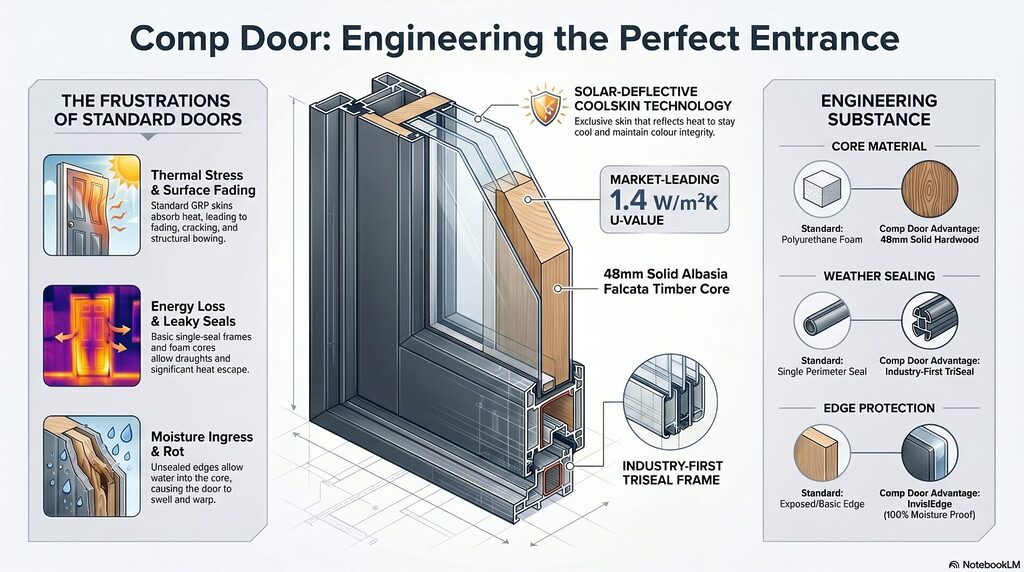
Comp Door’s brochure positions the 1.4 W/m²K U-value as the headline thermal claim. To put that in context, lower numbers mean better insulation, and 1.4 is a strong figure for a solid timber-core composite door, which is exactly why the brochure highlights it as the first solid timber composite door to achieve this level.
But the number is not the whole story. The thermal performance is built on a few things working together.
The premium cross-laminated Albasia Falcata timber core sits at the heart of the door. The brochure describes it as thermally efficient and offering maximum security, which gives the door a stronger, more stable structure to start with. A solid timber core helps the door retain warmth far better than the lighter, hollower constructions you sometimes see at the budget end of the market.
The TriSeal frame then plays its part. It is described in the brochure as a market-leading system for better weatherproofing and performance. In simple terms, it helps reduce the gaps and weak points around the edges of the door, which is where a lot of heat loss and draughts actually happen.
CoolSkin technology adds another layer, helping the door cope with temperature changes and maintain optimum performance over time.
And the new Avantis Autofire lock contributes too, thanks to its industry-leading compression adjustment, which helps keep the door pulled tightly into the frame. The brochure points out specifically that this is not just about keeping intruders out, but about keeping the elements out as well.
When all of those things work together, the result is not just a strong number on a spec sheet. It is a front door that feels properly sealed in everyday life.
What it feels like once it is fitted
Homeowners tend to judge comfort in very human ways. They notice if the hallway feels less cold. They notice if the entrance feels quieter and more solid. They notice if the front of the house seems less affected by bad weather. They notice if the home simply feels better put together.
Thermal performance is one of those benefits that people often do not lead with when they shop, but end up valuing enormously once they have lived with the door for a while.
This is especially relevant if the current front door is old, tired or underperforming. Many homeowners do not fully realise how much their existing door is letting the entrance down until it is replaced. If the old door is draughty, poorly sealed or simply not very substantial, the difference after fitting a stronger thermally performing product can feel much bigger than expected.
That is part of the Comp Door appeal. It is not just there to improve the front elevation visually. It is also there to improve the lived experience of the entrance.
Now, the sensible caveat is that thermal performance is not just about the slab in isolation. Installation quality matters. The frame matters. The overall configuration matters. Glass choice can matter too. So no homeowner should read a brochure number and assume it alone guarantees perfection. But as a product proposition, Comp Door clearly makes thermal performance a genuine strength rather than a vague claim.
How it compares
For homeowners looking at lower-cost alternatives, the question often becomes whether the cheaper door will still feel good enough once installed. This is one of the areas where Comp Door can justify the step up. It is not simply offering a nicer face on the front of the house. It is offering a more complete entrance solution that supports comfort as well as appearance.
For homeowners comparing against premium competitors, the question is slightly different. It becomes less about whether the door is “good enough” and more about which product offers the strongest all-round value. Again, Comp Door does well here because it combines thermal performance with strong styling, security credentials and smart reassurance through Kubu. That broader balance makes the thermal story more powerful, because it is part of a full modern homeowner proposition rather than a single isolated benefit.
The emotional side of thermal performance
It is also worth saying that better thermal performance supports a better emotional experience of the home.
That may sound a bit lofty for a front door, but it is true.
A cold, draughty entrance never feels welcoming. It never feels finished. It can subtly undermine the impression of the whole house. A stronger door that feels warmer and more settled does the opposite. It makes the entrance feel more intentional, more secure and more comfortable. That changes how the home feels as you arrive and leave every day.
This is one reason Comp Door often feels like more than just a new door. If chosen well, it can feel like a meaningful upgrade to the way the home performs and the way it is experienced.
So is Comp Door thermally better?
Yes, that is clearly one of the areas it is designed to compete strongly. The brochure’s 1.4 W/m²K U-value, TriSeal frame and CoolSkin technology all support the argument that this is a front door built to offer better comfort and weather performance, not just good looks.
For homeowners, the real takeaway is simpler: a better front door should not just improve the outside of the house. It should improve how the entrance feels from the inside too. That means less draughty, more settled, more comfortable, more solid, and more in keeping with the rest of the home.
That is what “thermally better” actually means in real life. And if the goal is to buy a front door that looks right, feels right and makes the house work a little better every day, then Comp Door makes a very strong case.
Why Choose GFD Homes for Your Comp Door?
If thermal performance is part of what matters to you, then the buying experience should be just as straightforward as the product itself.
At GFD Homes, we offer instant priced quotes, so you can compare real numbers clearly without waiting for inflated in-home sales pricing, dragged-out appointments or the usual quoting nonsense. That means you can assess style, performance and value properly on your own terms.
You can also do it all from the comfort of your home or office. No wasted evenings. No pressure. No wondering whether the quote has been adjusted to suit the sales routine.
Just clear pricing, simple online ordering and a smarter way to buy a front door that genuinely improves your home.
If you are considering Comp Door for its stronger thermal performance as well as its premium appearance, GFD Homes gives you the easiest and most transparent way to explore it properly.
🛒 Browse the full collection at www.gfdhomes.co.uk
📞 Or call 01642 309576 for expert guidance and a no-pressure quote.
In a rush? Why not contact us via Whatsapp
Browse Our Article
- What Are Energy Ratings and How Are They Calculated?
- Front Door: Keep Your Home Warm and Energy Bills Low
- Energy Ratings Explained: What UK Homeowners Need to Know
- Looking for Trade Products? Explore The Trade Village
FAQ’s
1. What is the standard thermal U-value of a Comp Door? A standard Comp Door achieves an exceptional U-value of 1.4 W/m²K. In the door industry, lower numbers represent better thermal insulation. This rating makes it the very first solid timber-core composite door on the UK market to reach such an energy-efficient baseline without requiring expensive extra upgrades.
2. How does the internal core construction prevent heat from escaping? Many budget composite doors use a lightweight polyurethane foam core that struggles to retain heat and warps under seasonal temperature changes. This range relies on a dense, 48mm cross-laminated Albasia Falcata hardwood core, which acts as a heavy, natural thermal insulator to keep your home warm.
3. What is a TriSeal frame and how does it stop whistling winter drafts? While standard front doors feature a single weather seal that can allow cold air to leak through as the house settles, this innovative system introduces an industry-first triple-seal perimeter. This gives you three independent, continuous weather barriers to block out driving rain and freezing winds.
4. How does the door’s lock mechanism improve its thermal performance? The integrated Avantis Autofire locking system features advanced mechanical compression adjustment. Every time the door slams shut, the heavy-duty deadbolts automatically pull the timber slab tightly and evenly into the weather seals, ensuring the perimeter remains fully airtight.