Last Updated on 23 October 2026 by IanR
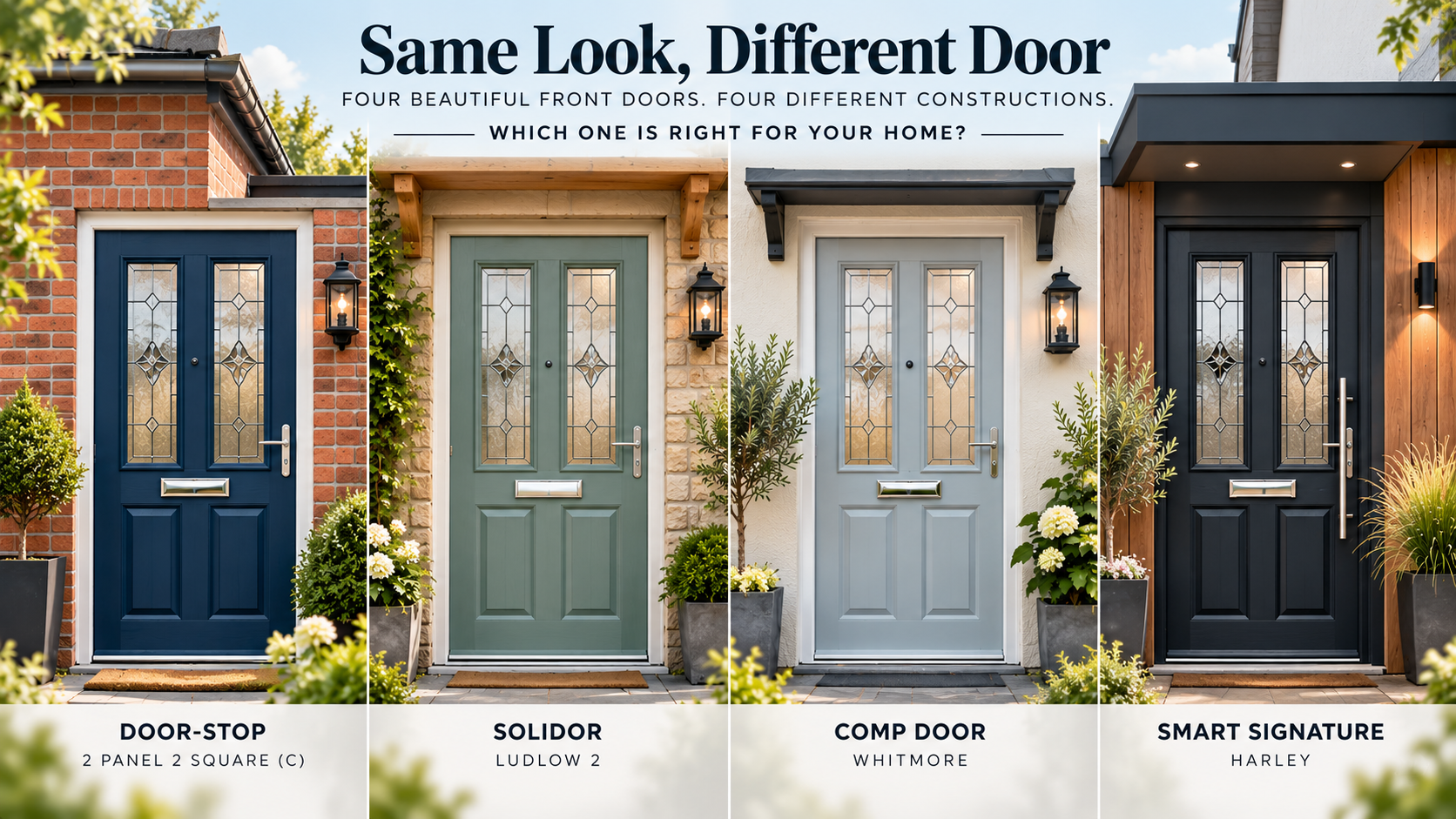
Four traditional front doors with similar appearances are compared: Door-Stop, Solidor, Comp Door and Smart Signature Harley. Their GRP composite, solid timber-core and aluminium constructions differ in price, finishes, thermal performance, security features and available configurations.
The guide outlines the strengths and considerations of each option, including affordability, solid construction, weather sealing, automatic locking, colour choices and aluminium finishes. It recommends comparing complete doorset specifications, including U-values, glazing, frames, locks and installation, according to individual priorities.
Four beautiful front doors. Four different constructions. Which one should you choose?
Buying a new front door should be exciting. After all, it’s one of the first things people notice about your home, something you’ll use every day and an investment you’ll probably live with for many years.
But there’s a problem.
Unless you work in the door industry, chances are you’ve never really thought about how a front door is constructed. You know what you like the look of. You probably have a colour in mind. You might even know whether you want traditional or contemporary styling. But what happens when you discover that four doors, all looking remarkably similar, can have very different prices, specifications and characteristics?
Which one is better?
And perhaps more importantly, which one is better for you? At GFD Homes, we’ve been helping homeowners choose entrance doors for around 20 years. We understand that while we deal with doors every day, you might be choosing your very first replacement front door.
So rather than simply telling you which door to buy, we’re going to explain the differences. For this comparison, we’ve selected four traditional front doors from four different manufacturers. The Door-Stop 2 Panel 2 Square (C), Solidor Ludlow 2, Comp Door Whitmore and Smart Signature Harley. All four offer a similar traditional appearance, but underneath their attractive finishes, they’re quite different products.
Let’s explore why.
First, why do these four doors look so similar?
Traditional two-panel entrance doors have been popular in British homes for generations. Their appeal is simple. The proportions are familiar, the design is balanced, and the combination of solid panels with two glazed sections works beautifully across a wide variety of properties. Whether you own a Victorian terrace, a 1930s semi-detached house, a modern family home or a countryside property, this style can look entirely at home.
That’s why several manufacturers offer their own interpretations.
But while the appearance might be similar, the materials, construction methods, security features and finishing options can differ considerably. Think of it a little like buying a car. Two cars might look similar, have four wheels and comfortably carry your family, but what lies beneath the bodywork can make them very different propositions.
Front doors are no different.
Option 1: Door-Stop 2 Panel 2 Square (C)
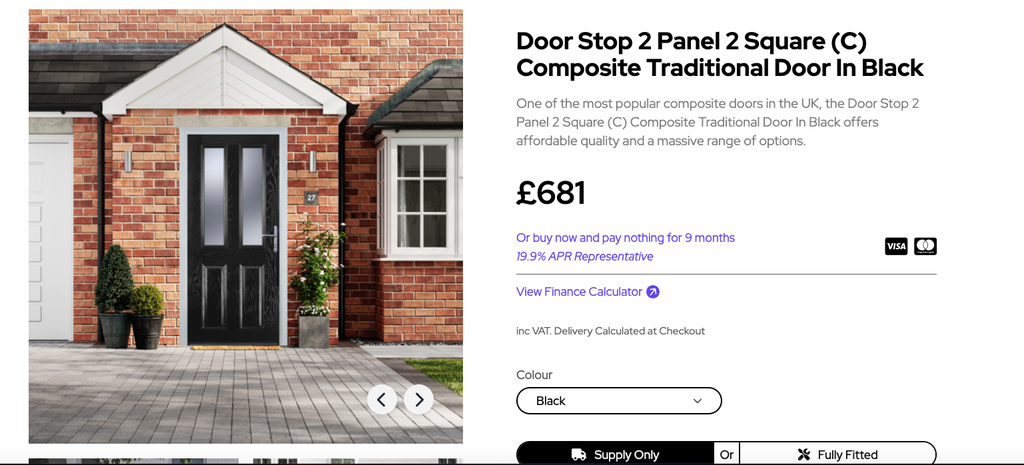
A practical, affordable traditional composite door
The Door-Stop 2 Panel 2 Square (C) is an excellent starting point for understanding the composite door market. Door-Stop uses a GRP composite construction rather than the solid timber core found in some competing products. GRP stands for Glass Reinforced Plastic, a durable material commonly used for the external skin of composite doors.
The door combines this protective outer skin with an insulated internal construction. The result is a practical entrance door designed to offer good thermal performance, security and weather resistance without an unnecessarily high purchase price.
Why might you choose Door-Stop?
For many homeowners, value for money is a major consideration. Perhaps you’re replacing an ageing uPVC door, renovating a property or simply want to improve your home’s appearance without spending more than necessary.
Door-Stop offers a traditional appearance, a substantial choice of colours and glazing options, and modern multipoint locking. At GFD Homes, the range also includes a three-star Ultion security cylinder as standard.
Another attraction is availability. Selected Door-Stop configurations can be delivered from seven working days, subject to specification, stock and location. That can be particularly useful if you’re working towards a renovation deadline.
What should you consider?
The construction differs from a solid timber-core door. Some homeowners specifically prefer the feel and weight associated with a solid-core product. Others are perfectly happy with an insulated GRP construction, particularly when it delivers the appearance and performance they need at a competitive price.
Neither preference is necessarily right or wrong. It’s about understanding what matters to you.
Explore the Door-Stop 2 Panel 2 Square (C) at GFD Homes.
Option 2: Solidor Ludlow 2
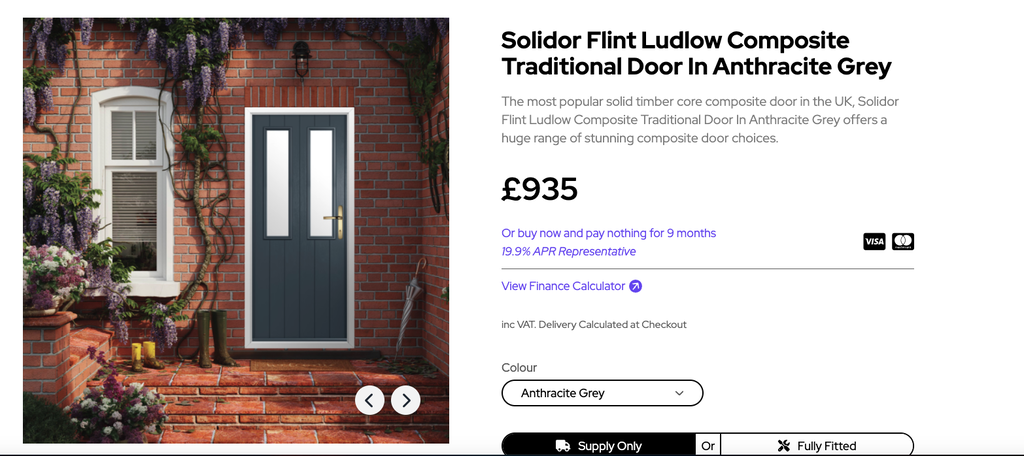
Traditional appearance with a substantial solid timber core
The Solidor Ludlow 2 takes a different approach. Although its traditional styling is similar to the Door-Stop design, its construction centres around a 48mm solid hardwood core. This is one of Solidor’s defining characteristics. Rather than using a predominantly insulating core, Solidor builds its door around a substantial engineered timber structure, protected by durable external skins
For homeowners, this creates a door with a distinctly solid feel.
Why might you choose Solidor?
Some people place considerable importance on how a door feels when opening and closing it. They like the reassuring weight and substantial construction associated with timber-core doors. Solidor appeals to this preference.
The Ludlow 2 also benefits from an extensive range of decorative glazing, colours and traditional door furniture. If you’re renovating a period property, for example, you might want a particular shade of green, traditional glazing and heritage-style hardware. Solidor provides plenty of opportunities to create that appearance. There are also additional configurations available across the range, including stable doors, double doors and certain arched arrangements.
What should you consider?
A solid timber core doesn’t automatically make a door better in every respect. For example, thermal performance depends on the complete doorset, including its glazing, seals, frame and construction. A heavier door isn’t automatically more secure either. The locking system, cylinder, hinges, frame and installation all contribute to security.
Solidor may appeal if you value substantial construction, traditional detailing and personalisation. But those benefits should be considered alongside the final price and your individual requirements.
Explore the Solidor Ludlow 2 at GFD Homes.
Option 3: Comp Door Whitmore
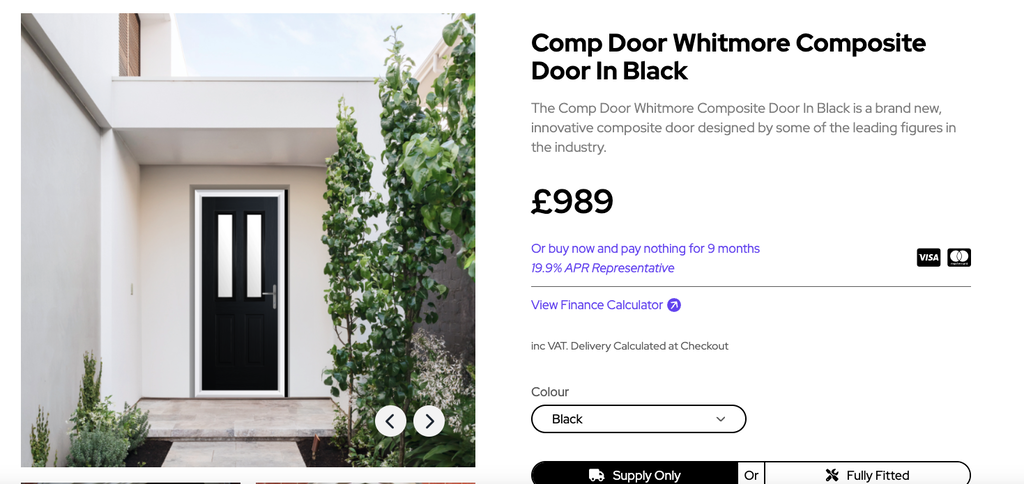
Solid timber construction with a different approach to performance
The Comp Door Whitmore is another traditional design featuring a 48mm solid timber core. At first glance, that might make it sound very similar to Solidor. However, Comp Door has developed its range around several particular performance features. These include its CoolSkin technology, triple-sealed frame design and automatic locking system.
Why might you choose Comp Door?
One concern homeowners sometimes have about composite doors is seasonal movement. Entrance doors are exposed to changing temperatures, direct sunlight, rain and cold weather throughout the year.
Different materials respond to these conditions in different ways. Comp Door’s CoolSkin technology is designed to help minimise the effects of temperature-related movement, including bowing and warping.
The range also incorporates a triple-sealed frame arrangement intended to improve weather resistance. Another interesting feature is automatic locking. Depending on the chosen specification, this can provide additional convenience by engaging the locking mechanism without requiring the homeowner to manually lift the handle.
For busy households, that might be an attractive feature.
What should you consider?
Comp Door and Solidor both offer solid timber-core construction, but their design priorities differ.
Solidor provides extensive traditional styling and customisation.
Comp Door places particular emphasis on construction technology, weather sealing and locking convenience.
That doesn’t mean one is universally superior. Instead, it gives homeowners another set of characteristics to consider.
If your existing door has suffered from draughts, difficult locking or seasonal movement, these features may be especially relevant.
Explore the Comp Door Whitmore at GFD Homes.
Option 4: Smart Signature Harley
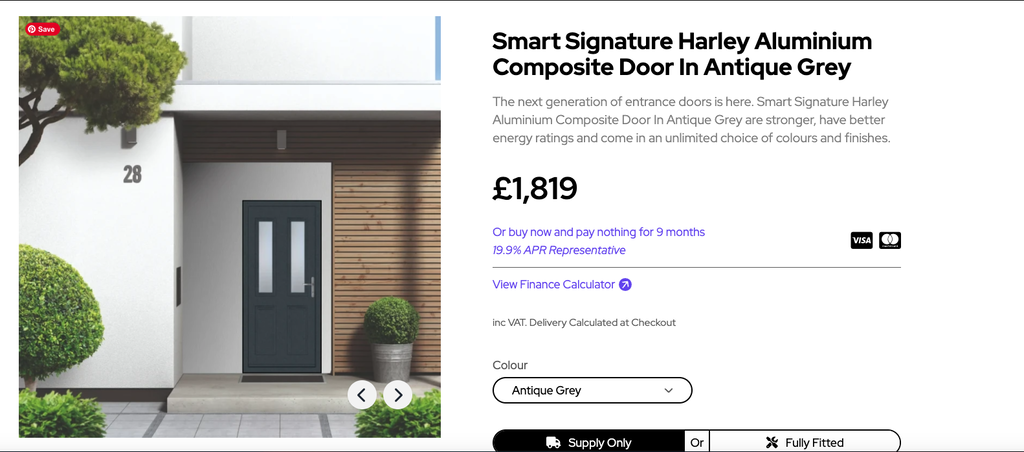
Traditional styling with aluminium construction
Our fourth option introduces a rather different material. The Smart Signature Harley recreates a familiar traditional entrance door appearance using an aluminium-based construction. And that changes the conversation considerably.
The Harley features a 60mm aluminium door leaf and a double-rebated aluminium outer frame. Rather than reproducing traditional styling using GRP and timber-based construction, it combines that appearance with the characteristics of an aluminium entrance door system.
Why might you choose Smart Signature?
One of aluminium’s greatest attractions is its versatility. Smart Signature offers an extensive selection of colours, including specialist finishes and a broad choice of RAL shades. This can be particularly appealing if you’re trying to coordinate your front door with aluminium windows, bifolding doors or other architectural features.
The aluminium frame and door leaf can also be finished to match, creating a coordinated appearance. The Harley includes premium textured finishes within its range, alongside a 25-year paint guarantee, subject to the manufacturer’s terms.
For homeowners planning a larger renovation, these details may be important.
What should you consider?
Aluminium entrance doors generally occupy a different price position from more conventional GRP composite products. That additional expenditure may be worthwhile if you particularly value the material, finish, colour flexibility or coordination with other aluminium products.
However, choosing aluminium doesn’t automatically mean every aspect of performance will be superior. As with any entrance door, the exact thermal specification, glazing, locking arrangement and installation all matter. For some homes, aluminium will be an excellent fit.
For others, a traditional composite door may provide everything required.
Explore the Smart Signature Harley at GFD Homes.
Four Traditional Front Doors Compared: What’s the Difference?
| Feature | Door-Stop 2 Panel 2 Square | Solidor Ludlow 2 | Comp Door Whitmore | Smart Signature Harley |
|---|---|---|---|---|
| Door construction | Insulated GRP composite | Solid timber-core composite | Solid timber-core composite | Aluminium composite |
| Core / door thickness | Insulated composite construction | 48mm solid hardwood core | 48mm solid timber core | 60mm aluminium door leaf |
| Traditional appearance | Yes | Yes | Yes | Yes |
| Colour selection | Wide range | Extensive range | Extensive range | Very extensive, including specialist finishes |
| Decorative glazing | Available | Extensive options | Extensive options | Available |
| Security | Multipoint locking, 3-star Ultion cylinder | Multipoint locking, 3-star Ultion cylinder | Multipoint locking; specification dependent | Multipoint locking, 3-star cylinder |
| Thermal insulation | Insulated construction | Solid timber-core construction | Solid timber-core construction | Thermally engineered aluminium system |
| Weather resistance | GRP external skin | Protective external skins | CoolSkin technology and triple sealing | Aluminium construction with double-rebated frame |
| Resistance to bowing | Designed for normal UK conditions | Designed for normal UK conditions | CoolSkin technology | Manufacturer’s No Bow guarantee |
| Locking convenience | Conventional multipoint locking | Conventional multipoint locking | Automatic locking technology available | Multipoint locking |
| Maintenance | Low | Low | Low | Low |
| Customisation | Good | Extensive | Extensive | Extensive, particularly colours and finishes |
| Delivery | Selected options from 7 working days | Subject to configuration | Subject to configuration | Subject to configuration |
| Price positioning | Value-focused | Mid-market to premium | Mid-market to premium | Premium |
| Particularly worth considering for | Homeowners prioritising affordability and practicality | Homeowners wanting substantial construction and traditional detailing | Homeowners interested in weather sealing and locking technology | Homeowners wanting aluminium construction and specialist finishes |
So what actually makes one front door better than another?
Here’s where we think homeowners should approach the decision differently. Rather than asking which manufacturer makes the best door, start by asking what you want your new door to achieve.
1. Construction: Does the material matter to you?
Door-Stop uses an insulated GRP composite construction.
Solidor and Comp Door feature substantial solid timber cores.
Smart Signature uses an aluminium-based construction.
All three approaches have their merits.
If you value a substantial timber-core feel, Solidor or Comp Door might appeal. If affordability and practical performance are priorities, Door-Stop deserves consideration. If aluminium construction and extensive finishing choices appeal, Smart Signature offers another direction.
2. Energy efficiency: Which door keeps your home warmer?
This is one of the most important questions, particularly with household energy costs remaining a consideration. But comparing doors based purely on their core material can be misleading. Instead, look at the U-value of the complete doorset.
A U-value measures how readily heat passes through a building component. The lower the U-value, the better its thermal insulation.
Glazing choices, door dimensions and the frame can all influence the result. Ask for the performance figures relevant to your chosen configuration rather than assuming one material must automatically be warmer.
3. Security: Is a heavier door more secure?
Not necessarily. A secure entrance door relies on several components working together.
These include the door construction, locking mechanism, cylinder, hinges, frame and installation. A substantial timber-core door may feel reassuringly solid, but weight alone isn’t a security rating. Look for recognised security testing, appropriate locking specifications and quality installation.
4. Appearance: How much personalisation do you want?
This is where the differences become particularly interesting. Perhaps you simply want a smart black traditional front door with clear glazing.
All four ranges could be worth exploring.
But what if you want decorative heritage glass, unusual door furniture or a specific colour? Solidor’s traditional styling options may appeal. Comp Door offers its own selection of colours and hardware. Door-Stop provides extensive choices at an accessible price point. Smart Signature offers particularly broad colour and finish possibilities.
The best choice may depend on the precise appearance you’re trying to create.
5. Budget: What are you actually paying for?
A higher price doesn’t necessarily mean you’re buying a better-looking door. Sometimes you’re paying for different construction materials. Sometimes it’s additional technology, finishing processes, design flexibility or particular manufacturing features.
The important thing is to understand those differences.
If two doors look almost identical and both meet your needs, there’s nothing wrong with choosing the more affordable option. Equally, if a particular construction or feature matters to you, paying more may represent good value. The aim should be to buy the right door, not simply the cheapest or most expensive.
Four doors, four different reasons to choose
Let’s simplify everything we’ve discussed.
Door-Stop 2 Panel 2 Square (C)
Worth considering if you want traditional styling, practical GRP composite construction, competitive pricing and potentially shorter delivery times.
Solidor Ludlow 2
Worth considering if you prefer a substantial solid timber core, traditional detailing, extensive decorative options and a wide range of configurations.
Comp Door Whitmore
Worth considering if you like solid timber-core construction but are particularly interested in temperature-related movement resistance, weather sealing and automatic locking technology.
Smart Signature Harley
Worth considering if you prefer aluminium construction, coordinated aluminium frames, specialist finishes and extensive colour choices.
None of these descriptions means the other doors cannot satisfy the same requirements.
They’re simply useful starting points.
Which door would we recommend?
The answer might surprise you.
We wouldn’t recommend one until we’d understood what matters to you. We’d want to know about your property, the appearance you’re hoping to achieve, your budget and whether any particular performance features are important. We’d also ask about your existing door.
Is it draughty? Does it stick in summer? Is the locking mechanism difficult to operate? Are you replacing it because it’s worn out, or simply because you want something more attractive?
Your answers can help narrow the choices considerably.
A homeowner replacing a basic white uPVC door might have completely different priorities from someone renovating a Victorian property or building a contemporary home. And that’s precisely why we offer several manufacturers rather than just one.
Frequently asked questions
Is Solidor better than Door-Stop?
Neither is automatically better for every homeowner. Solidor uses a solid hardwood core and offers extensive customisation, while Door-Stop uses an insulated GRP composite construction and is particularly competitive on price. The right choice depends on your priorities.
Is Comp Door better than Solidor?
Both offer 48mm solid timber-core construction. Comp Door emphasises features such as CoolSkin technology, triple sealing and automatic locking, while Solidor offers extensive traditional styling and configuration choices. Compare the precise specifications and features that matter to you.
Are aluminium front doors better than composite doors?
Aluminium doors offer different characteristics, particularly in construction, colour choice and finishing. Composite doors can offer excellent security, insulation and appearance at different price points. Neither material is automatically the best choice for every home.
Which front door is the most energy efficient?
Compare the declared U-values for the exact doorset configurations you’re considering. Glazing, frames and specifications affect thermal performance, so a comparison based on material alone is insufficient.
Do expensive front doors last longer?
Not necessarily. Longevity depends on manufacturing quality, materials, exposure, maintenance and installation. A higher price may reflect additional features or finishing options rather than a guaranteed longer lifespan.
Your home. Your door. Your choice.
At GFD Homes, we believe choosing a front door should be about understanding your options rather than being persuaded towards one particular manufacturer. We’ve spent around two decades working with entrance doors. We understand the differences between manufacturers, materials and construction methods.
But we also recognise that most homeowners don’t buy front doors every day. That’s why we’re creating this series. To explain the differences, answer the questions that matter and help you make a confident, informed decision.
Whether you choose Door-Stop, Solidor, Comp Door or Smart Signature, the most important thing is that you understand what you’re buying and why it’s right for your home.
Explore all four designs at GFD Homes, experiment with colours and glazing, and create your own personalised quotations. And if you’re unsure which option suits your requirements, speak to our team. We’re here to help you choose the right door, not simply sell you a door.