
Last Updated on 20 July 2026 by Team GFD
Is a Comp Door thermally better than standard alternatives? Explore U-values, triple-seal frameworks, and energy-saving designs at GFD Homes.
What You’ll Learn:
- Deciphering the Numbers: Meeting Tomorrow’s UK Building Regulations Today
- The Multi-Barrier Defense: How Timber Cores and TriSeal Frames Lock In Warmth
- Stopping the Silent Enemy: Moisture Control and Thermal Core Longevity
- What You’ll Actually Notice: Living with a Completely Weatherproofed Entrance
(Estimated Reading Time: 5-6 Minutes)

Introduction
Thermal performance rarely tops the wish list when homeowners start shopping for a new front door. Most people immediately look at colour choices, styling details, and physical security first. However, once winter rolls around and the door is fully installed, indoor comfort is the exact thing you will notice most—and it is precisely where a premium Comp Door shines.
When you purchase your door through GFD Homes, you aren’t just buying a standard, drafty replacement. You are investing in an engineered barrier that fundamentally changes how your entrance handles the British weather, keeping your energy bills down and your hallway perfectly warm.
What the numbers mean
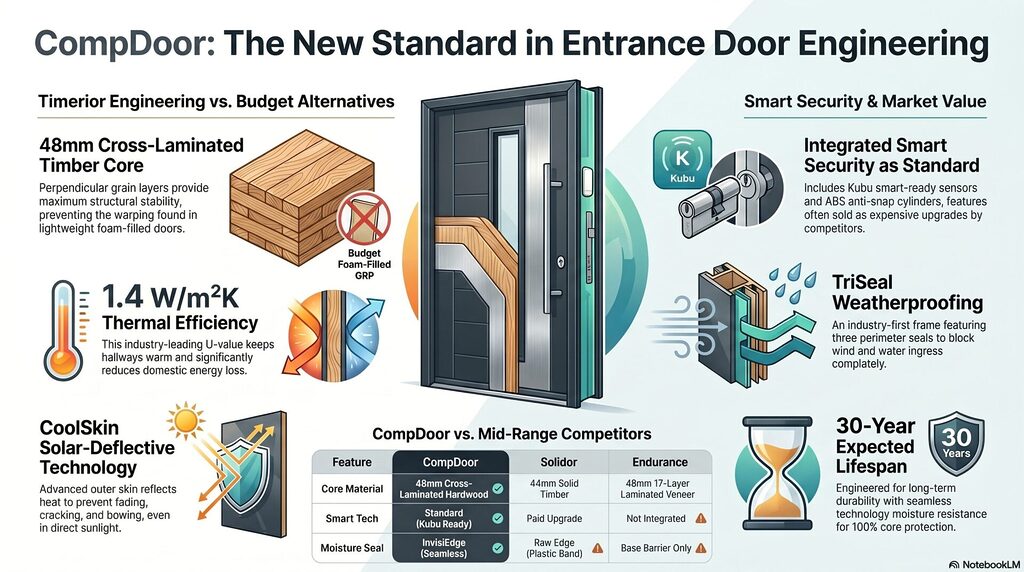
Comp Door achieves a 1.4 W/m²K U-value as standard – the level that incoming UK Building Regulations will soon require across the board. That means a Comp Door fitted today already meets tomorrow’s standards, without upgrades or compromise.
But most homeowners aren’t buying a U-value. They’re buying a warmer hallway, fewer draughts and a front entrance that feels more like part of the home than a weak point in the building fabric.


Listen on Apple Podcasts Now

Listen on Spotify Now
Why the construction matters
The 48mm cross-laminated Albasia Falcata timber core is naturally thermally stable – denser and more insulating than foam-core alternatives. That creates a better base level of thermal performance before any additional features come into play.
The TriSeal frame – Comp Door’s industry-first triple-seal system – adds three weatherproof barriers where most doors use one. That means significantly less opportunity for cold air to find a way through at the frame perimeter.
CoolSkin, the outer skin technology, reduces the thermal stress on the door’s surface by reflecting rather than absorbing heat. That doesn’t just protect appearance – it helps maintain stable temperatures through the door itself.
The InvisiEdge contribution
Moisture ingress is one of the quieter enemies of thermal performance. When water penetrates a door’s edges and reaches the core, it degrades insulating properties over time. Comp Door’s InvisiEdge system seals the edges to 100% moisture resistance, protecting the thermal core from long-term damage.
What you’ll actually notice
A calmer, warmer entrance. Less draught around the frame. A hallway that feels more settled in winter. The subtle but noticeable sense that the house is better sealed. These aren’t dramatic effects – but they’re things homeowners consistently mention after installation, and they make a real difference to how comfortable and complete the home feels.
The verdict
Yes, Comp Door is thermally strong. Not just by specification, but by design – every element of the construction contributes to better thermal performance. For homeowners who want a door that improves the house inside as well as outside, that’s a genuinely meaningful advantage.
Why buy your Comp Door from GFD Homes?
We offer instant, transparent pricing on the full Comp Door range – no in-home sales visits, no pressure, no surprises. Compare options, configure your door and get a real quote from the comfort of your home.
🛒 Browse the full collection at www.gfdhomes.co.uk
📞 Or call 01642 309576 for expert guidance and a no-pressure quote.
In a rush? Why not contact us via Whatsapp
Browse Our Articles
- Comp Door: Everything You Need to Know
- Doors and Windows Security Questions from GFD Homes
- Doors and Windows: Security & Energy from GFD Homes
- Looking for trade products? Visit our trade site, The Trade Village
FAQ’s
1. What is the standard U-value of a Comp Door, and why does it matter? A standard Comp Door achieves an impressive U-value of 1.4 W/m²K, which already complies with strict, upcoming UK Building Regulations. This exceptionally low rating means the door restricts heat loss far better than older uPVC or cheap foam-filled alternatives.
2. How does the core material contribute to energy savings? Instead of using lightweight polyurethane foam that struggles to retain heat, this range is built around a dense, 48mm cross-laminated Albasia Falcata hardwood core. Timber is a natural insulator, providing a robust thermal baseline that keeps cold air out and warm air in.
3. Why is the TriSeal frame such an important feature for thermal efficiency? Most composite doors on the market rely on a single weather seal, which can let drafts slip through as the building settles. The industry-first TriSeal frame introduces three independent perimeter barriers, completely blocking out howling winds and freezing temperatures.
4. How does the InvisiEdge system protect the door’s insulation properties? If water gets past a door’s edge and dampens the internal core, the material’s thermal insulation properties severely degrade over time. The InvisiEdge system creates a 100% moisture-resistant seal, permanently keeping the inner timber core completely dry and fully functional.