Last Updated on 20 July 2026 by Team GFD
Is a composite back door worth the investment? Explore the security, insulation, and layout practicalities of upgrading your rear entrance with GFD Homes.
What You’ll Learn:
- The Vulnerability Factor: Why Rear Entrances Require Elite Structural Defense
- Everyday Comfort: Eliminating Cold Kitchen Drafts with Targeted Insulation
- Balancing Light and Privacy: Choosing Glazed or Solid Panels for Utility Spaces
- Coordinated Value: Erasing Opaque Quoting Routines for Instant Online Pricing
(Estimated Reading Time: 7-9 Minutes)
Introduction
When homeowners think about upgrading their external thresholds, the front door usually gets all the attention. It is the primary entrance, the focus of curb appeal, and the most public-facing part of the property. However, once that project is successfully finished, a secondary question almost always follows: is it actually worth upgrading the back door too?
For the majority of UK properties, the answer is a resounding yes. A residential back door might not have the showpiece role of a front entrance, but it carries a massive amount of functional responsibility. It dictates your home’s rear security, regulates kitchen and utility room temperatures, and impacts how practical your garden transitions feel day to day. Upgrading through GFD Homes allows you to transform a weak, neglected rear exit into a high-performance asset.
Why homeowners upgrade a back door
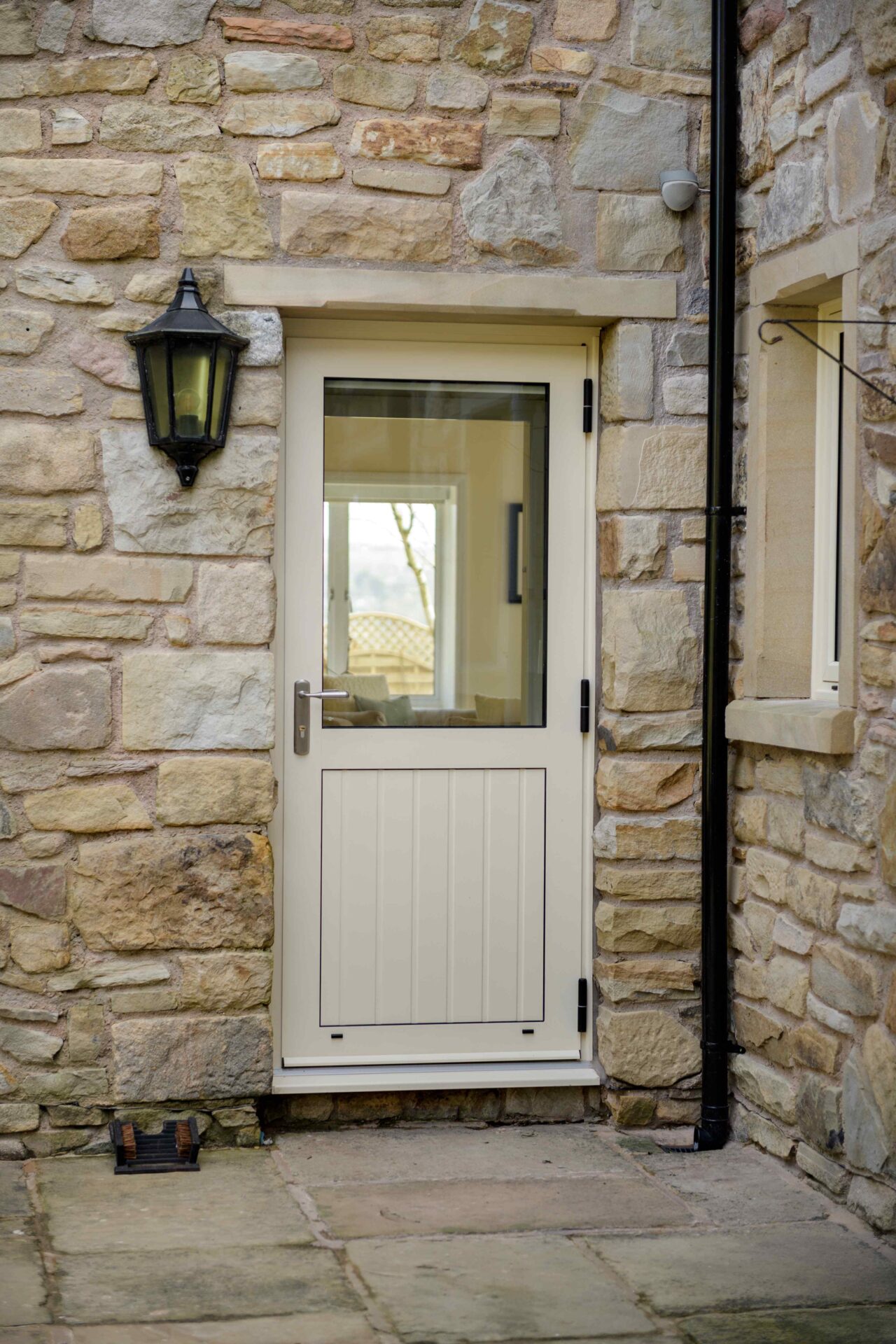
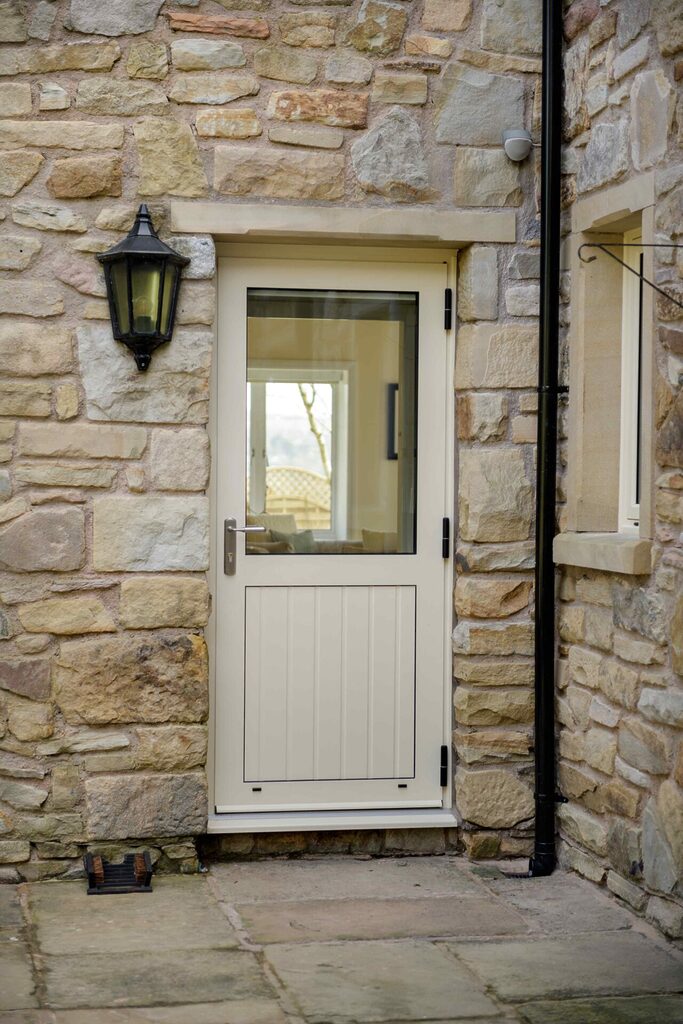
A back door often gets overlooked for years because it’s out of sight — at the side, the rear, by the kitchen or opening to the garden. Because it’s less public-facing, it slips down the priority list, which often means it ends up being one of the weakest-performing parts of the home: draughty, tired, not especially secure, or simply not suited to how you now live.
A better back door can improve the security of the property, help the rear of the house feel warmer and more complete, and make everyday use more pleasant. If it opens into a kitchen, utility or family garden space, that can make a bigger difference than people expect.
What is a composite back door?
It’s simply a composite door used at the rear or side of the property rather than as the main front entrance — though the role can be slightly different. A front door is chosen heavily around kerb appeal; a back door has to balance practicality more, perhaps letting in more light, working with a kitchen layout, offering strong security, or suiting an opening used more casually and more often.
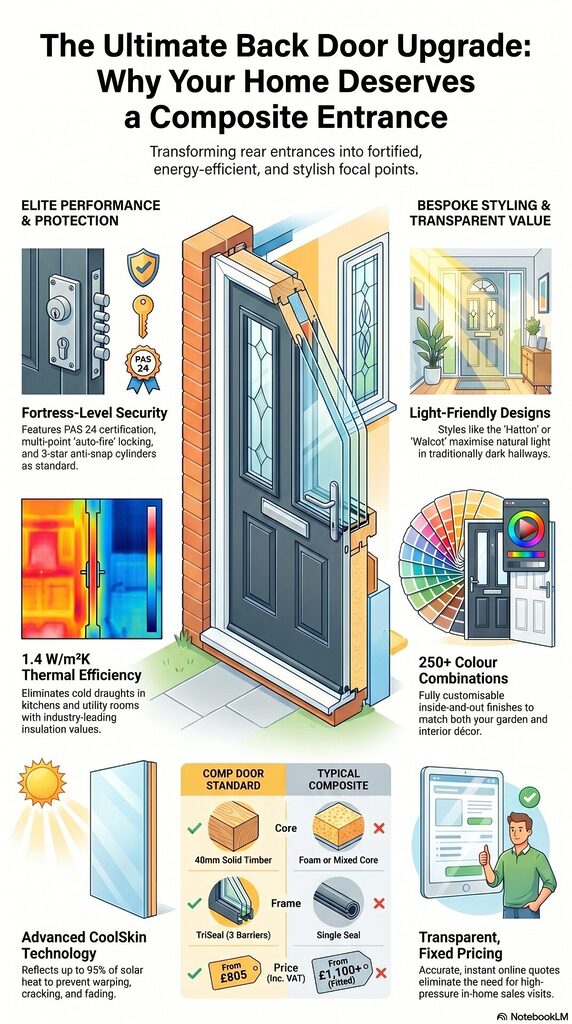
The composite part still matters. Built from different materials and components for strength, security, weather resistance and appearance, it feels more premium and substantial than a basic door. Comp Door’s range is built around a 48mm solid timber core, a 1.4 W/m²K U-value, PAS-24:2022, an ABS security cylinder as standard, advanced locking and a wide choice of styles, colours and glass — so a composite back door isn’t just a prettier rear entrance, it’s a genuinely stronger and more complete one.
Are composite back doors more secure?
For many homeowners this is the biggest reason to upgrade. The rear of the house often feels more exposed than the front — less visible from the road, less actively watched, more shielded by gardens and fences. That makes rear-door security an important part of the overall picture, and it’s where a better composite door justifies itself quickly. A good one shuts with authority, feels substantial and offers a more serious locking and cylinder story than a weak alternative. Comp Door makes a clear case here with PAS-24:2022, an ABS anti-snap cylinder as standard, advanced locking and the Avantis Autofire system. The takeaway is simple: a stronger back door helps the whole property feel more secure — because the rear entrance is rarely an afterthought for intruders, even if it has been for the household.
Are composite back doors warmer?
Yes — often one of the biggest day-to-day improvements. Back doors are frequently in parts of the home where warmth matters: kitchens, breakfast rooms, utilities and family spaces. If the old door is draughty, the room feels it. A better composite back door helps the entrance feel settled and part of the home rather than a thin barrier against the weather. Comp Door’s 1.4 W/m²K U-value, plus CoolSkin, TriSeal and InvisiEdge, supports a rear door that does more than close the opening — it helps the back of the house feel warmer, calmer and better finished.
Do composite back doors let in enough light?
This is one of the most practical design questions. A rear door often opens into a space where natural light matters more than at the front — a darker kitchen, a narrow utility or a rear hallway. So style choice is important: some homeowners want a more solid, private rear entrance, others want large glazed sections, many want something in between. A broad range helps. Comp Door includes light-friendly styles like Hatton and Walcot, as well as more restrained or solid designs for those who prefer privacy — so you don’t have to choose between “practical” and “premium”.
Which styles work best for a back door?
It depends on the role the rear entrance plays. If it opens from a kitchen or dining space and you want brightness, a more glazed design makes sense. If it’s mainly about security, side access or a utility route, a more solid or semi-glazed design is better. And if the rear entrance is characterful — a cottage or farmhouse-style home — a stable door is worth considering; Comp Door includes one in its wider range. The best back-door style isn’t always the one that matches the front exactly; it’s the one that works best for the rear of the property. A front door is often chosen to make a statement; a back door is often chosen to make life easier.
Can a back door still look good?
Yes — and this is where many homeowners are pleasantly surprised. A composite back door doesn’t have to look purely functional. Upgrading the rear entrance can make the whole back of the property feel more cared for, which matters if it overlooks a garden, patio or entertaining area. In those cases the back door is part of the view and the feel of the home, not just a practical exit. A better rear door can make the kitchen feel more finished, the patio view look better and the whole property feel more consistently high-standard — valuable even if it’s less obvious than front-door kerb appeal.
Are composite back doors good value?
For many homes, yes — because a composite back door improves several things at once: security, warmth, appearance, practicality and the daily experience of using the entrance. You’re not just paying for another external door; you’re paying for a rear entrance that feels more substantial and more in keeping with the rest of the home. That’s especially true once the front door has been upgraded and a tired back door suddenly looks even more out of place. Value also improves when the buying process is clear: a transparent quote and easy comparison make the spend feel worthwhile; a muddled, inflated, sales-driven route does the opposite.
When might it not be worth it?
If the rear entrance is rarely used, the budget is very tight and the existing door still performs acceptably, the upgrade can wait. And if the only priority is the absolute lowest cost, a more basic door may feel easier in the short term — though that’s not the same as the better long-term choice. A composite back door is most worthwhile where you want a meaningful improvement in how the door feels, performs and contributes to the home.
The bottom line
Very often, yes — especially if the current back door feels insecure, cold, tired or out of step with the rest of the home. A good composite back door improves the rear entrance in more ways than people expect: warmer, safer, more practical and more complete. And if it’s a door you use every day, that improvement becomes even more valuable. Done properly, a composite back door isn’t just a rear access point — it’s part of how the home works.
🛒 Browse the full collection at www.gfdhomes.co.uk
📞 Or call 01642 309576 for expert guidance and a no-pressure quote.
In a rush? Why not contact us via Whatsapp
Browse Our Article
- Composite Door Prices Made Simple
- The Best Composite Doors for Kerb Appeal
- Your Guide to the Best Quality Composite Doors
- Looking for Trade Products? Explore The Trade Village
FAQ’s
1. Why is upgrading a back door often more critical for security than a front door? The rear or side of a property is inherently more vulnerable because it is shielded from street-level view by fences, hedges, or garages. Intruders target rear entryways far more often than prominent front entries. A premium composite setup addresses this risk directly, implementing PAS-24:2022 multi-point hook locks and an anti-snap ABS diamond-grade cylinder as standard.
2. How does a premium rear door improve thermal comfort in a kitchen or utility room? Older rear doors are notorious for being thin, drafty, and poorly sealed, which can quickly make an adjacent kitchen or breakfast room feel freezing in the winter. A solid-core composite build uses an energy-efficient design to achieve an impressive 1.4 W/m²K thermal U-value, turning a notoriously cold part of the house into a warm, comfortable space.
3. Can I configure a back door to let in maximum natural light? Absolutely. While some homeowners prefer maximum privacy for a side alley exit, others want to bring light into a dark rear hallway or utility space. You can select full glazed models like the Hatton or large window configurations like the Walcot, pairing them with obscure privacy glass to flood your interior with daylight without exposing your home to neighbors.
4. How does GFD Homes make buying a composite rear door straightforward? Instead of forcing you to endure a high-pressure, in-home sales presentation just to find out how much a simple rear entry costs, GFD Homes offers total pricing transparency. Our interactive online 3D designer tool lets you custom-configure your dimensions, style family, glass type, and color options to see an instant, fixed price update in real time.